Mosasaurus hoffmannii Skeletal Reconstruction
SPECIMENS USED:
Mosasaurus hoffmannii - CCMGE 10/2469, MNHN AC 9648, IRSNB 1624, IRSNB R24, IRSNB R26, IRSNB R299, IRSNB R300, NHMM 006696, NHMM 1193024, NHMM 2013001, RMDRC 14-015
Mosasaurus conodon - AMNH 1380, MOR 006
Mosasaurus sp. - UCMP 61221
Moanasaurus mangahouangae - S34-S77
BONES USED:
Skull - Heavily modified from the composite as seen in Street and Caldwell, 2017. Substituted the parietal provided with that from CCMGE 10/2469, and a modified brain case from Lingham-soliar 1995. Fixed the pterygoid to better fit the holotype's provided in the paper. Further details are listed in Street and Caldwell 2017. Sclerotic ring restored from NHMM 2013001.
Vertebrae - Bones restored from pictured elements from various specimens. Atlas from IRSNB R 300. Axis from IRSNB R26. Cervicals restored from NHMM 006696. Dorsals restored from IRSNB 1624, NHMM 006696 and S34-S77. Tail mostly restored from S34-S77 to fit UCMP 61221. Vertebrae count based on details listed for M. hoffmannii and M. conodon, Russell 1967 and Ikejiri and Lucas, 2015.
Ribs - Primarily speculative based on written descriptions provided by Russell 1967 and Lingham-Soliar 1995. Otherwise poorly documented in photo format save for a couple of fragments.
Pectoral girdle - Scapulocoracoid restored from IRSNB R26 and NHMM 006696. Damage restored with reference to MOR 006. Sternal elements speculative.
Forelimb - Restored from IRSNB R26, IRSNB R 299, NHMM 1193024, and RMDRC 14-015.
Pelvic Girdle - NHMM 006696.
Hindlimb - Restored from AMNH 1380, MNHN AC 9648, and NHMM 006696.
REFERENCES:
Grigoriev, D.V., 2014. "Giant Mosasaurus hoffmanni (Squamata, Mosasauridae) from the Late Cretaceous (Maastrichtian) of Penza, Russia." Труды Зоологического института РАН, 318(2), pp.148-167.
Ikejiri, T. and Lucas, S.G., 2015. Osteology and taxonomy of Mosasaurus conodon Cope 1881 from the Late Cretaceous of North America. Netherlands Journal of Geosciences, 94(1), pp.39-54.
Konishi, T., Newbrey, M.G. and Caldwell, M.W., 2014. A small, exquisitely preserved specimen of Mosasaurus missouriensis (Squamata, Mosasauridae) from the Upper Campanian of the Bearpaw Formation, western Canada, and the first stomach contents for the genus. Journal of Vertebrate Paleontology, 34(4), pp.802-819.
Lindgren, J., Caldwell, M.W., Konishi, T. and Chiappe, L.M., 2010. Convergent evolution in aquatic tetrapods: insights from an exceptional fossil mosasaur. PloS one, 5(8), p.e11998.
Lindgren, J., Polcyn, M.J. and Young, B.A., 2011. Landlubbers to leviathans: evolution of swimming in mosasaurine mosasaurs. Paleobiology, 37(3), pp.445-469.
Lingham-Soliar, T., 1995. "Anatomy and functional morphology of the largest marine reptile known, Mosasaurus hoffmanni (Mosasauridae, Reptilia) from the Upper Cretaceous, Upper Maastrichtian of the Netherlands." Philosophical Transactions of the Royal Society of London B: Biological Sciences, 347(1320), pp.155-172. Vancouver
Russell, D.A., 1967. Systematics and morphology of American mosasaurs (Reptilia, Sauria) (Vol. 23). Peabody Museum of Natural History, Yale University. Vancouver
Street, H.P., and Caldwell, M.W., 2016. “Rediagnosis and redescription of Mosasaurus hoffmannii (Squamata: Mosasauridae) and an assessment of species assigned to the genus Mosasaurus,” Geological Magazine. Cambridge University Press, 154(3), pp. 521–557. doi: 10.1017/S0016756816000236.
Wiffen, J., 1980. Moanasaurus, a new genus of marine reptile (Family Mosasauridae) from the Upper Cretaceous of North Island, New Zealand. New Zealand journal of geology and geophysics, 23(4), pp.507-528. Vancouver
ACKNOWLEDGEMENTS:
Dr. Johan Lindgren for his advice on the tail fluke.
Dr. Mike Everhart for his advice on the rib cage and the sclerotic ring.
Dr. Anthony Maltese for his advice on the rib cage.
Dr. Hallie Street for her advice on the vertebral column.
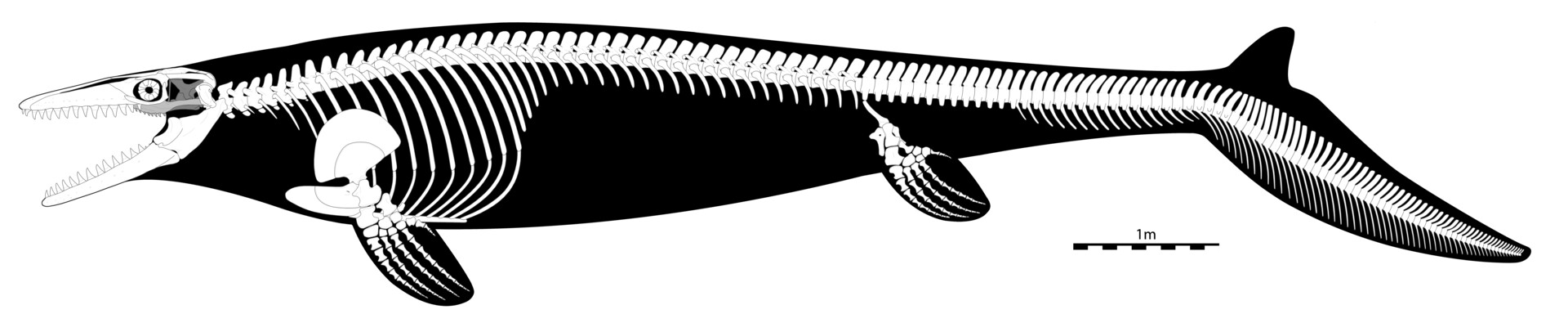
Mosasaurus hoffmannii skeletal reconstruction.
Scaled to represent the holotype specimen, MNHN AC 9648.